
Article Categories
- All Categories
-
 Data Structure
-
 Networking
-
 RDBMS
RDBMS
-
 Operating System
-
 Java
Java
-
 MS Excel
-
 iOS
iOS
-
 HTML
HTML
-
 CSS
CSS
-
 Android
-
 Python
-
 C Programming
-
 C++
C++
-
 C#
C#
-
 MongoDB
-
 MySQL
MySQL
-
 Javascript
-
 PHP
PHP
-
 Economics & Finance
Design a TM which recognizes palindromes over = {a, b}
Algorithm
Step 1 - If there is no input, reach the final state and halt.
Step 2 - If the input = “a?, then traverse forward to process the last symbol = “a?. Convert both a?s to B?.
Step 3 - Move left to read the next symbol.
Step 4 - If the input = “b?, replace it by B and move right to process its equivalent “B? at the rightmost end.
Step 5 - Convert the last ’b’ to ‘B’.
Step 6 - Move left and process step 2 – 5 until there are no more inputs to process.
Step 7 - If the machine reaches the final state after processing the entire input string, then the string is a palindrome that halts the machine.
Turing Machine
The turing machine is as follows −
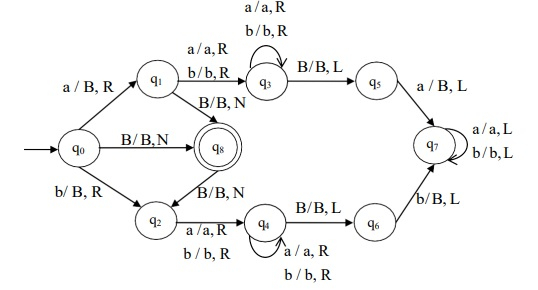
The Turing machine, M is given by M = (Q, Σ, Γ, δ, q0, B, F)
Where,
Q = {q0, q1, q2, q3, q4, q5, q6, q7, q8}
Σ = {a, b}
Γ = {a, b, B}
δ ⇒ Given by the above mentioned transition diagram,
q0 = {q0}
B = {B}
F = {q8}
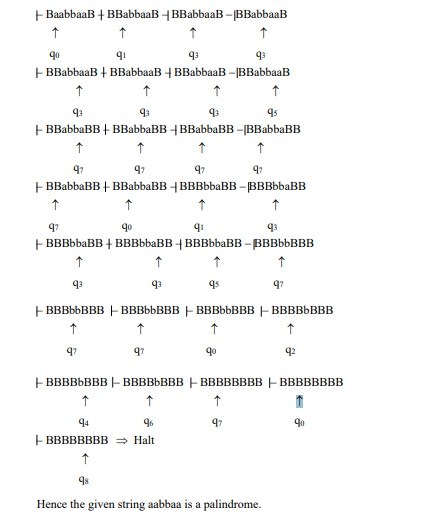
Consider a string aabbaa, as shown below −

32K+ Views
