Systems development is systematic process which includes phases such as planning, analysis, design, deployment, and maintenance. Here, in this tutorial, we will primarily focus on −
It is a process of collecting and interpreting facts, identifying the problems, and decomposition of a system into its components.
System analysis is conducted for the purpose of studying a system or its parts in order to identify its objectives. It is a problem solving technique that improves the system and ensures that all the components of the system work efficiently to accomplish their purpose.
Analysis specifies what the system should do.
It is a process of planning a new business system or replacing an existing system by defining its components or modules to satisfy the specific requirements. Before planning, you need to understand the old system thoroughly and determine how computers can best be used in order to operate efficiently.
System Design focuses on how to accomplish the objective of the system.
System Analysis and Design (SAD) mainly focuses on −
The word System is derived from Greek word Systema, which means an organized relationship between any set of components to achieve some common cause or objective.
A system is an orderly grouping of interdependent components linked together according to a plan to achieve a specific goal.
A system must have three basic constraints −
A system must have some structure and behavior which is designed to achieve a predefined objective.
Interconnectivity and interdependence must exist among the system components.
The objectives of the organization have a higher priority than the objectives of its subsystems.
For example, traffic management system, payroll system, automatic library system, human resources information system.
A system has the following properties −
Organization implies structure and order. It is the arrangement of components that helps to achieve predetermined objectives.
It is defined by the manner in which the components operate with each other.
For example, in an organization, purchasing department must interact with production department and payroll with personnel department.
Interdependence means how the components of a system depend on one another. For proper functioning, the components are coordinated and linked together according to a specified plan. The output of one subsystem is the required by other subsystem as input.
Integration is concerned with how a system components are connected together. It means that the parts of the system work together within the system even if each part performs a unique function.
The objective of system must be central. It may be real or stated. It is not uncommon for an organization to state an objective and operate to achieve another.
The users must know the main objective of a computer application early in the analysis for a successful design and conversion.
The following diagram shows the elements of a system −
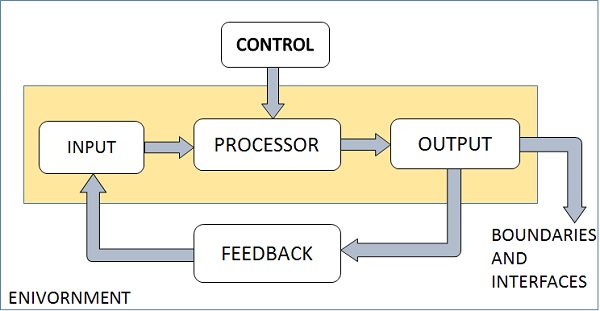
The main aim of a system is to produce an output which is useful for its user.
Inputs are the information that enters into the system for processing.
Output is the outcome of processing.
The processor is the element of a system that involves the actual transformation of input into output.
It is the operational component of a system. Processors may modify the input either totally or partially, depending on the output specification.
As the output specifications change, so does the processing. In some cases, input is also modified to enable the processor for handling the transformation.
The control element guides the system.
It is the decisionmaking subsystem that controls the pattern of activities governing input, processing, and output.
The behavior of a computer System is controlled by the Operating System and software. In order to keep system in balance, what and how much input is needed is determined by Output Specifications.
Feedback provides the control in a dynamic system.
Positive feedback is routine in nature that encourages the performance of the system.
Negative feedback is informational in nature that provides the controller with information for action.
The environment is the supersystem within which an organization operates.
It is the source of external elements that strike on the system.
It determines how a system must function. For example, vendors and competitors of organizations environment, may provide constraints that affect the actual performance of the business.
A system should be defined by its boundaries. Boundaries are the limits that identify its components, processes, and interrelationship when it interfaces with another system.
Each system has boundaries that determine its sphere of influence and control.
The knowledge of the boundaries of a given system is crucial in determining the nature of its interface with other systems for successful design.
The systems can be divided into the following types −
Physical systems are tangible entities. We can touch and feel them.
Physical System may be static or dynamic in nature. For example, desks and chairs are the physical parts of computer center which are static. A programmed computer is a dynamic system in which programs, data, and applications can change according to the user's needs.
Abstract systems are non-physical entities or conceptual that may be formulas, representation or model of a real system.
An open system must interact with its environment. It receives inputs from and delivers outputs to the outside of the system. For example, an information system which must adapt to the changing environmental conditions.
A closed system does not interact with its environment. It is isolated from environmental influences. A completely closed system is rare in reality.
Adaptive System responds to the change in the environment in a way to improve their performance and to survive. For example, human beings, animals.
Non Adaptive System is the system which does not respond to the environment. For example, machines.
Permanent System persists for long time. For example, business policies.
Temporary System is made for specified time and after that they are demolished. For example, A DJ system is set up for a program and it is dissembled after the program.
Natural systems are created by the nature. For example, Solar system, seasonal system.
Manufactured System is the man-made system. For example, Rockets, dams, trains.
Deterministic system operates in a predictable manner and the interaction between system components is known with certainty. For example, two molecules of hydrogen and one molecule of oxygen makes water.
Probabilistic System shows uncertain behavior. The exact output is not known. For example, Weather forecasting, mail delivery.
Social System is made up of people. For example, social clubs, societies.
In Human-Machine System, both human and machines are involved to perform a particular task. For example, Computer programming.
Machine System is where human interference is neglected. All the tasks are performed by the machine. For example, an autonomous robot.
It is an interconnected set of information resources to manage data for particular organization, under Direct Management Control (DMC).
This system includes hardware, software, communication, data, and application for producing information according to the need of an organization.
Man-made information systems are divided into three types −
Formal Information System − It is based on the flow of information in the form of memos, instructions, etc., from top level to lower levels of management.
Informal Information System − This is employee based system which solves the day to day work related problems.
Computer Based System − This system is directly dependent on the computer for managing business applications. For example, automatic library system, railway reservation system, banking system, etc.
A schematic model is a 2-D chart that shows system elements and their linkages.
Different arrows are used to show information flow, material flow, and information feedback.
A flow system model shows the orderly flow of the material, energy, and information that hold the system together.
Program Evaluation and Review Technique (PERT), for example, is used to abstract a real world system in model form.
They represent one pair of relationships such as activitytime or costquantity.
The Gantt chart, for example, gives a static picture of an activity-time relationship.
Business organizations are dynamic systems. A dynamic model approximates the type of organization or application that analysts deal with.
It shows an ongoing, constantly changing status of the system. It consists of −
Inputs that enter the system
The processor through which transformation takes place
The program(s) required for processing
The output(s) that result from processing.
There are three categories of information related to managerial levels and the decision managers make.
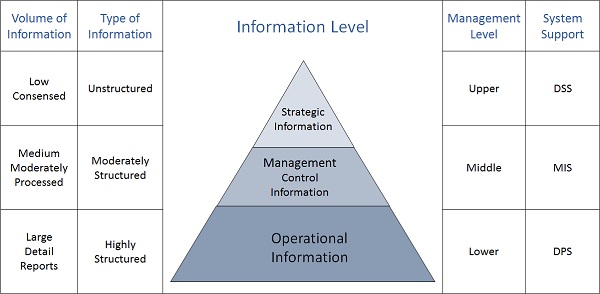
This information is required by topmost management for long range planning policies for next few years. For example, trends in revenues, financial investment, and human resources, and population growth.
This type of information is achieved with the aid of Decision Support System (DSS).
This type of Information is required by middle management for short and intermediate range planning which is in terms of months. For example, sales analysis, cash flow projection, and annual financial statements.
It is achieved with the aid of Management Information Systems (MIS).
This type of information is required by low management for daily and short term planning to enforce day-to-day operational activities. For example, keeping employee attendance records, overdue purchase orders, and current stocks available.
It is achieved with the aid of Data Processing Systems (DPS).