- GWT Tutorial
- GWT - Home
- GWT - Overview
- GWT - Environment Setup
- GWT - Applications
- GWT - Create Application
- GWT - Deploy Application
- GWT - Style with CSS
- GWT - Basic Widgets
- GWT - Form Widgets
- GWT - Complex widgets
- GWT - Layout Panels
- GWT - Event Handling
- GWT - Custom Widgets
- GWT - UIBinder
- GWT - RPC Communication
- GWT - JUnit Integration
- GWT - Debugging Application
- GWT - Internationalization
- GWT - History Class
- GWT - Bookmark Support
- GWT - Logging Framework
- GWT Useful Resources
- GWT - Questions and Answers
- GWT - Quick Guide
- GWT - Useful Resources
- GWT - Discussion
GWT - FlowPanel Widget
Introduction
The FlowPanel widget represents a panel that formats its child widgets using the default HTML layout behavior.
Class Declaration
Following is the declaration for com.google.gwt.user.client.ui.FlowPanel class −
public class FlowPanel
   extends ComplexPanel
      implements InsertPanel.ForIsWidget
Class Constructors
| Sr.No. | Constructor & Description |
|---|---|
| 1 |
FlowPanel() Constructor for empty Flow Panel. |
Class Methods
| Sr.No. | Function name & Description |
|---|---|
| 1 |
void add(Widget w) Adds a new child widget to the panel. |
| 2 |
void clear() Removes all child widgets. |
| 3 |
void insert(IsWidget w, int beforeIndex) |
| 4 |
void insert(Widget w, int beforeIndex) Inserts a widget before the specified index. |
Methods Inherited
This class inherits methods from the following classes −
com.google.gwt.user.client.ui.UIObject
com.google.gwt.user.client.ui.Widget
com.google.gwt.user.client.ui.Panel
com.google.gwt.user.client.ui.ComplexPanel
java.lang.Object
FlowPanel Widget Example
This example will take you through simple steps to show usage of a FlowPanel Widget in GWT. Follow the following steps to update the GWT application we created in GWT - Create Application chapter −
| Step | Description |
|---|---|
| 1 | Create a project with a name HelloWorld under a package com.tutorialspoint as explained in the GWT - Create Application chapter. |
| 2 | Modify HelloWorld.gwt.xml, HelloWorld.css, HelloWorld.html and HelloWorld.java as explained below. Keep rest of the files unchanged. |
| 3 | Compile and run the application to verify the result of the implemented logic. |
Following is the content of the modified module descriptor src/com.tutorialspoint/HelloWorld.gwt.xml.
<?xml version = "1.0" encoding = "UTF-8"?>
<module rename-to = 'helloworld'>
   <!-- Inherit the core Web Toolkit stuff.                        -->
   <inherits name = 'com.google.gwt.user.User'/>

   <!-- Inherit the default GWT style sheet.                       -->
   <inherits name = 'com.google.gwt.user.theme.clean.Clean'/>

   <!-- Specify the app entry point class.                         -->
   <entry-point class = 'com.tutorialspoint.client.HelloWorld'/>

   <!-- Specify the paths for translatable code                    -->
   <source path = 'client'/>
   <source path = 'shared'/>

</module>
Following is the content of the modified Style Sheet file war/HelloWorld.css.
body {
   text-align: center;
   font-family: verdana, sans-serif;
}

h1 {
   font-size: 2em;
   font-weight: bold;
   color: #777777;
   margin: 40px 0px 70px;
   text-align: center;
}

.gwt-CheckBox {
   margin: 10px;
}
Following is the content of the modified HTML host file war/HelloWorld.html.
<html>
   <head>
      <title>Hello World</title>
      <link rel = "stylesheet" href = "HelloWorld.css"/>
      <script language = "javascript" src = "helloworld/helloworld.nocache.js">
      </script>
   </head>

   <body>
      <h1>FlowPanel Widget Demonstration</h1>
      <div id = "gwtContainer"></div>
   </body>
</html>
Let us have following content of Java file src/com.tutorialspoint/HelloWorld.java which will demonstrate use of FlowPanel widget.
package com.tutorialspoint.client;

import com.google.gwt.core.client.EntryPoint;
import com.google.gwt.user.client.ui.CheckBox;
import com.google.gwt.user.client.ui.DecoratorPanel;
import com.google.gwt.user.client.ui.FlowPanel;
import com.google.gwt.user.client.ui.RootPanel;

public class HelloWorld implements EntryPoint {

   public void onModuleLoad() {
      // Create a flow panel
      FlowPanel flowPanel = new FlowPanel();

      // Add CheckBoxes to flow Panel
      for(int i = 1;  i <= 10; i++){
         CheckBox checkBox = new CheckBox("Item" + i);
         flowPanel.add(checkBox);
      }

      DecoratorPanel decoratorPanel = new DecoratorPanel();
      decoratorPanel.setWidth("500");
      decoratorPanel.add(flowPanel);

      // Add the widgets to the root panel.
      RootPanel.get().add(decoratorPanel);
   }
}
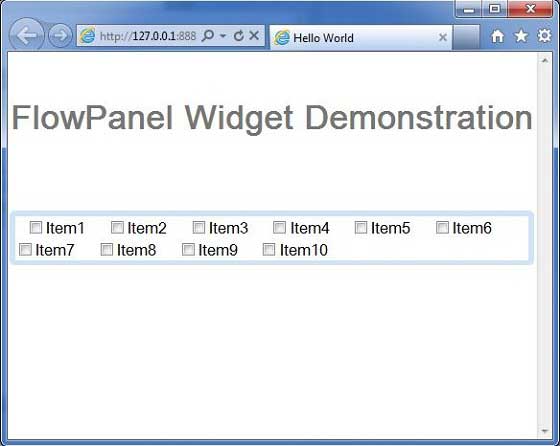
Once you are ready with all the changes done, let us compile and run the application in development mode as we did in GWT - Create Application chapter. If everything is fine with your application, this will produce following result −